
 العربية
 English
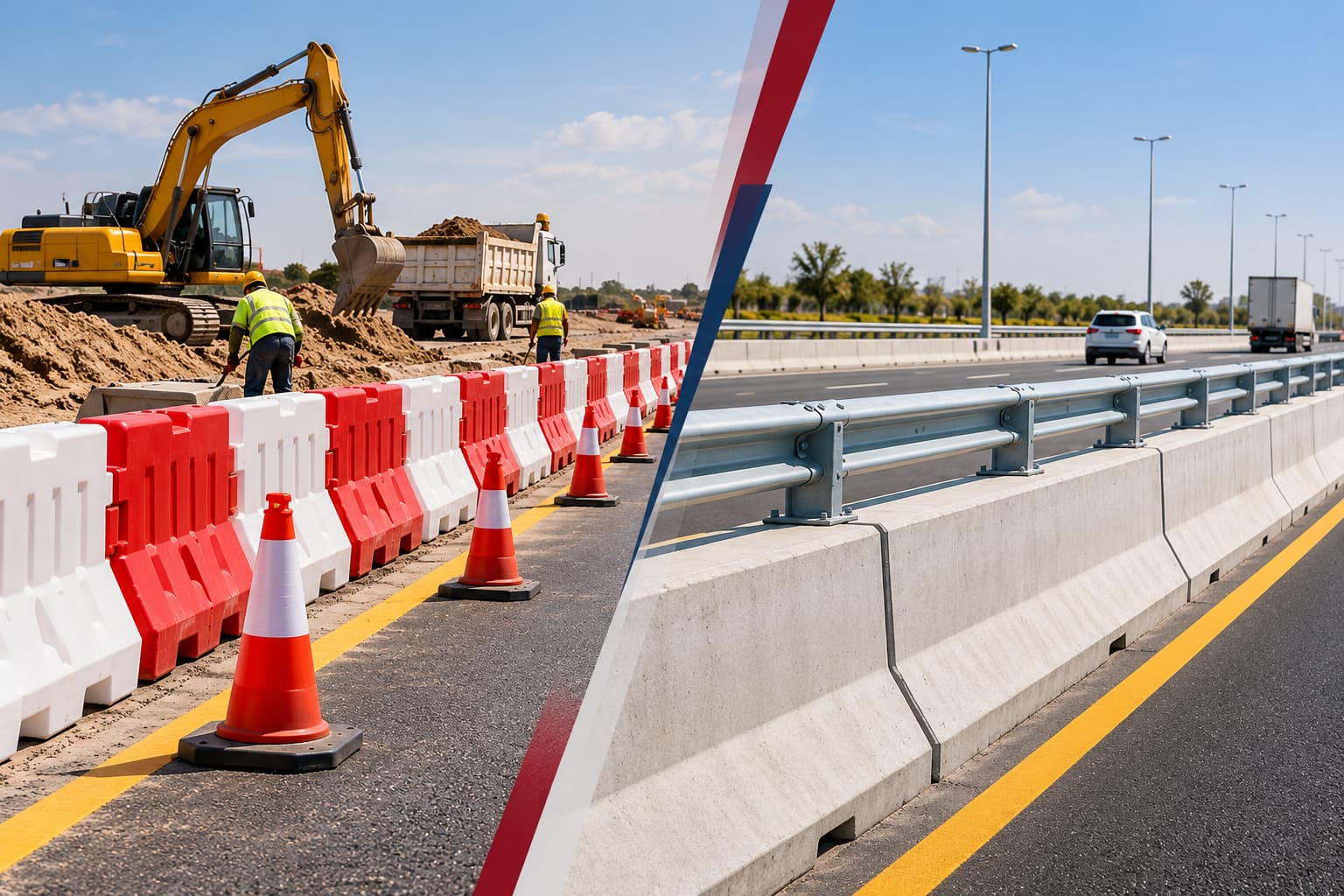

Temporary vs Permanent Safety Barriers: Applications and Selection
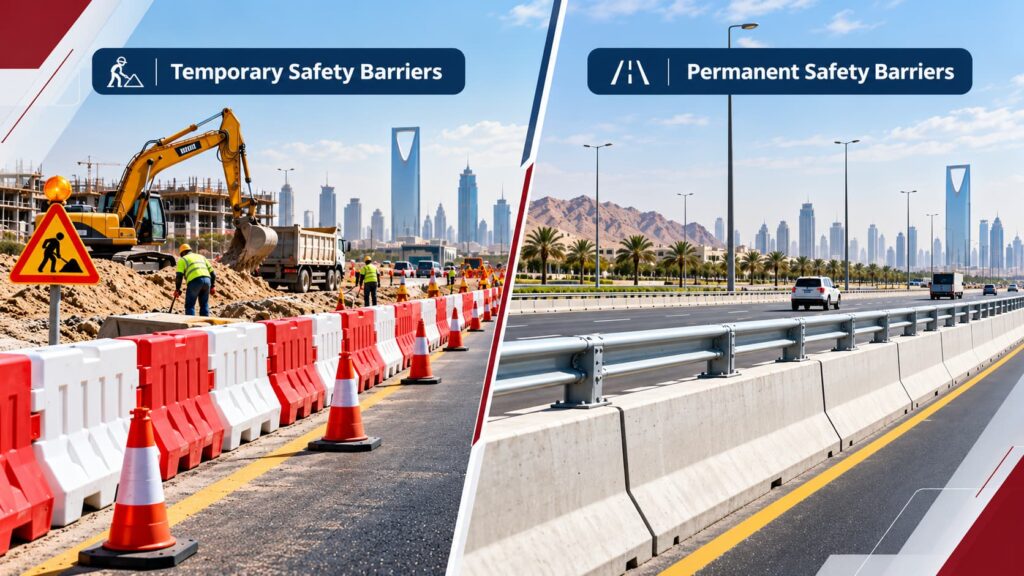
Temporary or permanent safety barriers are chosen depending on their function, project duration, length of the project, protection level and potential changes to the site layout. Temporary systems are best for work zones or areas with changing access points. Permanent systems are meant for sites that need a permanent, long-term safety or access-control solution.
Construction contractors, industrial facilities, warehouses, and commercial properties in Saudi Arabia need to select barriers based on vehicle movement, the hazards to be controlled, and the conditions in which the barriers will operate.
What Is the Difference Between Temporary and Permanent Safety Barriers?
The main difference is how long the barrier is intended to remain in place and whether the protected area is likely to change. However, the installation method alone does not determine the level of protection. Both temporary and permanent barriers must be suitable for the hazards they are intended to control.
Temporary Safety Barriers
Temporary safety barriers are used for protection or access control for a limited time or in areas with a changing layout. They are common on construction sites, roadworks, maintenance areas, and temporary driveways. These systems are designed to be moved, removed, or reused when the work is complete.
Permanent Safety Barriers
Permanent safety barriers are designed to provide separation, protection or restricted access at locations where these measures are continuously required. Permanent barriers can be found in factories, warehouses, industrial premises, and fixed routes for vehicles. Depending on the application, installation may require anchors, foundations or other fixed mounting arrangements.
Lifeline systems are configured around the way workers need to access and move through a work area. A horizontal lifeline is designed for movement along a horizontal route, while a vertical lifeline is used where workers move up or down. A rooftop lifeline is specifically planned for work carried out on or around a roof.
This means these terms do not always describe separate systems. They can describe different characteristics of the same installation.
Key Differences Between Temporary and Permanent Safety Barriers
| Factor | Temporary Safety Barriers | Permanent Safety Barriers |
|---|---|---|
| Duration | Used for short-term work or changing site needs | Intended for long-term use |
| Installation | Often easier to install and remove | May require fixed mounting or foundations |
| Movement | Can often be relocated or reused | Usually more difficult to relocate |
| Applications | Construction zones, roadworks, maintenance areas and temporary entrances | Factories, warehouses, industrial areas and fixed vehicle routes |
| Cost factors | Transport, rental, storage and repeated setup | Installation, foundations, inspection and maintenance |
| Main consideration | Flexibility and ease of relocation | Long-term stability, durability and required protection level |
The important point is that a horizontal lifeline is not automatically a rooftop lifeline. Horizontal describes the direction of movement, whereas rooftop identifies the work environment.
Applications of Temporary Safety Barriers
Temporary barriers are suitable where separation is required but site layout or access points change during operations. This way, contractors or the management can modify vehicle access points and traffic flow within the site.
Common applications include:
- Construction and maintenance zones: Separate active work areas from vehicle routes and help manage access while work is in progress.
- Temporary traffic lanes: Control vehicle entry and movement where permanent electrical infrastructure may be difficult to install.
- Emergency access routes: Support temporary access management when an approved site plan requires a moveable control point.
- Short-term industrial operations: Separate selected work areas or control vehicle entry during a specific activity.
Portable access control for changing work areas
A portable boom barrier controls vehicle entry and exit but is not an impact-rated crash barrier unless specifically tested and certified for that purpose. Solar-powered portable systems may reduce the need for a permanent power connection. Check lane width, operating frequency, solar exposure, safety features and access-control compatibility.
When Permanent Safety Barriers Are the Better Choice
Permanent safety barriers are recommended for situations where there is the need for constant protection and movement in a particular area. Permanent barriers suit locations requiring ongoing separation, equipment protection or controlled access. They may be integrated into a facility’s fixed site design. They can be integrated into the design of a building, either to keep vehicles apart from pedestrians, protect equipment or access to restricted areas.
Typical applications include:
Factories and warehouses: Separate pedestrian walkways from forklift routes and protect selected operational areas.
Loading bays: Define vehicle movement areas and protect workers and nearby equipment.
Industrial plants: Establish fixed separation around machinery, storage areas, columns, or restricted work zones.
Commercial and residential entrances: Manage vehicle entry through a fixed access-control point.
Permanent perimeter protection: Restrict vehicle access to designated areas with a system selected for the site’s security requirements.
Fixed protection for industrial facilities
Industrial safety systems may consist of guardrails, safety barriers, and bollards for pedestrian separation, equipment protection, and traffic control purposes. It is important to choose a barrier depending on the particular hazards and level of protection needed.
The guardrail, which is designed to protect pedestrians or machines, will not offer the same level of protection as a vehicle impact-resistant barrier. If impact resistance is required, ensure that the system is properly tested and is suitable for the particular impact situation.
The permanent vehicle entrance point may employ a boom barrier system. This device controls the traffic at the lane; however, it is used for a different purpose than the impact-resistant barrier.
Let’s Talk — Get Your Quote Fast
Need pricing, drawings, or quick product guidance? Contact Hitech Barrier and we’ll respond with a tailored quotation and technical support.
Key Factors to Consider When Selecting a Safety Barrier
Before specifying a barrier or designing a solution, evaluate the site’s operating environment and find out what hazard the barrier has to control. This helps prevent selection of a barrier system that does not provide the required level of protection.
1. Protection requirement
First determine whether the system must manage access, separate people from moving vehicles, protect equipment or resist a specified vehicle impact. It might become necessary to control pedestrians, restrict unauthorized access, separate the vehicles from the workforce, and provide protection to the equipment that can be affected by a vehicle.
However, all these tasks are not interchangeable. For instance, an object which creates a visual barrier may not be suitable for protecting workers from moving forklifts or road traffic.
2. Assess the installation area
Space availability, surface condition, lane width, pedestrian access, drainage, and access for equipment needed for installation must be checked. Permanent barriers may require proper foundation or anchorage. Portable barriers need proper stability and space for operation.
In case of protection from impact of vehicles, check the required deflection distance of the barrier. If a system needs working space, then that particular system cannot be installed properly in such locations. Where impact protection is required, verify tested deflection or working-width data and available clearances for the specific system.
3. Consider project duration and relocation
However, if the design of the site may be changed during the process of building, then a movable solution would be more suitable. However, if the area for operation remains the same and will require constant separation, then a permanent one would be better.
4. Check the operating environment
Barriers that work outdoors may have to withstand high temperatures, sunlight, dust, and corrosive conditions in some coastal regions. It is imperative to ensure that the right material, paint, and electrical parts, among other accessories, are selected based on their environment. For outdoor use, review temperature limits, UV exposure, dust ingress and coastal corrosion; confirm that materials, finishes and electrical parts suit the site.
5. Confirm performance and installation requirements
Check manufacturer documents related to the installation procedure, maintenance and any project approvals. In case the barrier is required to withstand the impact of vehicles, verify its performance rating based on its test results, rather than going by a description of the barrier as high strength or heavy duty. Request product drawings, test reports where relevant, fixing/foundation requirements, installation instructions and maintenance guidance.
Safety Barrier Selection for Projects in Saudi Arabia
The project location and site operation become key factor in the choice of barriers in Saudi Arabia. A construction site with temporary vehicle traffic routes will differ from a warehouse with fixed forklift lanes or an industrial site with fixed vehicle entrances.
For instance, a construction site will require the use of mobile site barrier in case of moving of the construction site, whereas a warehouse will require the use of fixed guardrails that separate pedestrians and vehicles as well as boom barrier installed at the entrance of the facility.
High temperatures and exposure to UV light can affect the longevity of the materials, and dust may interfere with the movement of mechanical parts or electronics. Assess the suitability of metal finishings and anti-corrosion treatment in case of the coastal location. Specify ambient-temperature ratings, ingress protection where relevant, corrosion/coating requirements and manufacturer maintenance guidance.
Use highway safety standards in accordance with the road authority and the relevant project requirements. The Saudi Ministry of Transport and Logistics Services provides information on the Kingdom’s road sector and its road-safety objectives. The specific requirements for a project should still be confirmed with the responsible authority and project documentation.
Final Considerations
Choice between temporary or permanent safety barriers would depend on factors such as danger involved, service life of barriers, requirement of mobility, layout of site, and the degree of safety needed. Permanent barriers should be employed in cases where there is a need for consistent separation or protection of operational areas.
Before making the final selection, ensure the product is suitable for the intended application and environment and meets the applicable installation, performance, and project-approval requirements in Saudi Arabia. Industrial safety solutions and portable solar gate systems can be considered when evaluating workplace protection and temporary vehicle-access needs.
Frequently Asked Questions
Can a permanent safety barrier be moved later?
Some permanent systems can be dismantled or relocated, but doing so may require specialist labour, new foundations, replacement fixings, or a fresh assessment of the installation. Check the system’s design and the impact of relocation on its performance.
Are temporary barriers suitable for vehicle-impact protection?
Only when the selected system is specifically designed, tested, and installed for the required vehicle-impact conditions. A portable traffic-control barrier or pedestrian barrier should not be assumed to provide crash protection.
What is the difference between a temporary traffic barrier and a crash barrier?
A temporary traffic barrier may guide or separate traffic, while a crash barrier is designed and tested to provide vehicle-impact protection under specified conditions. Not every temporary barrier is suitable for crash protection.
Do construction sites in Saudi Arabia need temporary fencing or safety barriers?
Some construction projects require temporary site fencing, barriers or other traffic-control measures, depending on the location, work scope and applicable requirements. Contractors should check the relevant municipal rules and approved site safety plan.
Which safety barriers are suitable for roadwork projects in Saudi Arabia?
The appropriate system depends on traffic speed, road layout, work-zone hazards and the level of protection required. Roadwork projects should follow the applicable Saudi road-code and traffic-management requirements rather than selecting barriers based on portability alone.