
 العربية
 English

Lifeline Safety Systems in Saudi Arabia: Selection, Standards & Applications
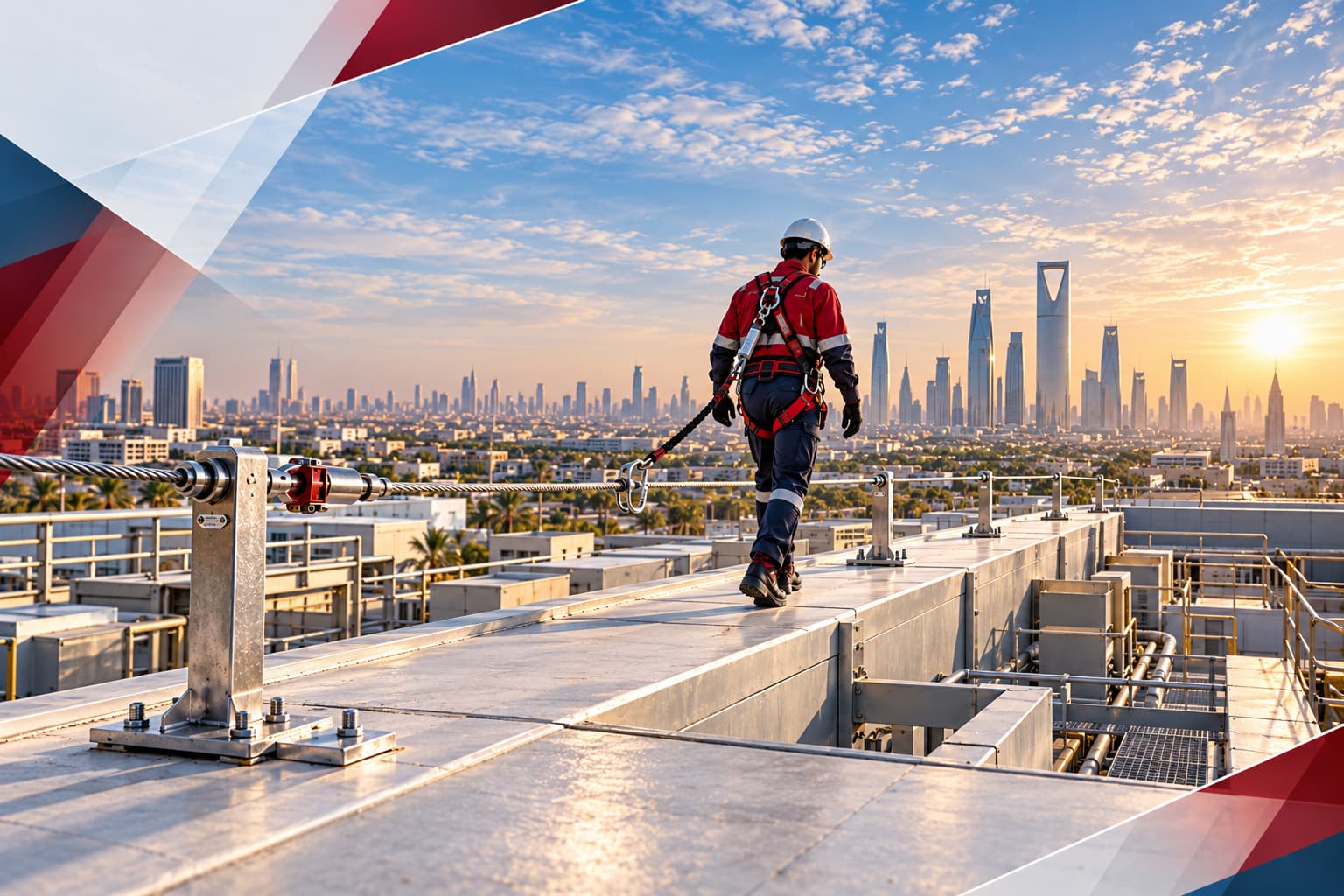
A lifeline safety system provides a planned attachment and travel path for workers who need to move through areas where conventional guardrails or other collective protection cannot fully control the fall hazard. The system must be selected around the building structure, work activity, access route, fall clearance, number of users, and the type of personal fall protection equipment being used.
In Saudi Arabia, fall protection should not be viewed as an isolated piece of equipment but rather as part of the broader occupational safety and health measures at the site. Saudi occupational safety requirements place duties on employers to identify workplace hazards, provide the necessary equipment and protection, and educate workers on how to use them.
Working at height is common across Saudi Arabia’s construction, industrial, commercial, logistics, and energy facilities. Roof inspections, maintenance, equipment servicing, the design, and access to elevated areas can expose workers to fall hazards when suitable protection is not provided.
What Does a Lifeline Safety System Do?
A lifeline safety system provides a designed connection or travel path for workers using compatible personal fall protection equipment while moving through a designated work area.
Depending on the application, a system may allow the user to:
- Travel horizontally along a roof or elevated work area.
- Move vertically while accessing towers, ladders, shafts, or other structures.
- Remain connected while carrying out inspection or maintenance work.
- Reach several work positions without repeatedly disconnecting from the protection system.
- Use a defined fall protection route where conventional edge protection is not practical.
A typical system can include a lifeline cable or rail, anchors, intermediate supports, end anchors, connection devices, and compatible personal fall protection equipment. The exact configuration depends on the system design and the structure to which it is attached.
A lifeline safety system provides a designed connection point or travel path for workers using compatible personal fall protection equipment.
Lifeline systems are installed based on the work area, direction of worker movement and intended use of the system. Lifeline systems are configured according to the direction of worker movement, the work area and how the system will be used.
Horizontal, vertical and rigid rail systems describe the travel arrangement, while permanent and temporary systems describe the intended duration and use of the protection.
| Lifeline System | What It Does |
|---|---|
| Horizontal Lifeline | Allows workers to move horizontally while remaining connected to the fall protection system. |
| Vertical Lifeline | Allows workers to move upward or downward while maintaining a continuous connection. |
| Rigid Rail System | Provides a fixed travel path that allows controlled movement along a rail. |
| Permanent Lifeline | Provides long-term fall protection where workers require repeated access and ongoing connection. |
| Temporary Lifeline | It provides temporary fall prevention and can be used for short-term work operations. |
Designing a Lifeline System Around Your Work Area
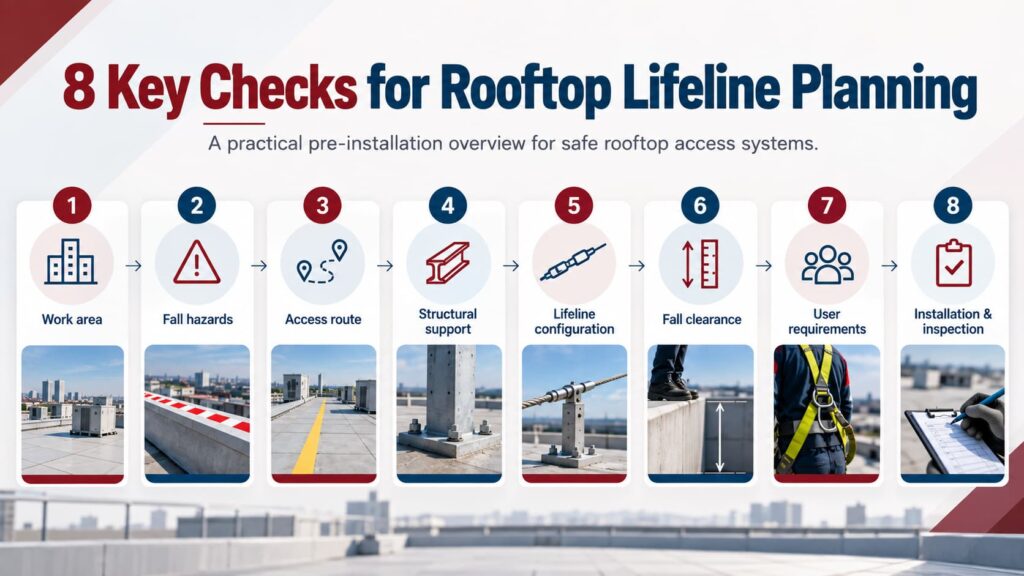
A lifeline safety system is designed around the site conditions, work activities and access requirements of the people who will use it. First, the work area and fall risks are evaluated. Then the access route, supporting structure, system configuration, necessary fall clearance, users, and final installation and inspection are taken into standard consideration.
The process starts with a site assessment and develops the system around the following factors:
Work area → Fall hazards → Access route → Structural support → Lifeline configuration → Fall clearance → User requirements → Installation and inspection
1. Assess the Work Area
Identify where workers must travel, where they will be working and where fall hazards are located. In the inspection, roof edges, openings, level changes, delicate surfaces, barriers, access points and locations that need routine maintenance should be considered.
2. Check the Supporting Structure
The lifeline must be connected to a structure capable of supporting the loads associated with the designed fall protection system.
The substrate, structural members, fixing locations, anchor arrangement, and connection method therefore need to be assessed before installation. A suitable-looking roof or steel member is not automatically a suitable anchor point.
3. Plan the Travel Route
The lifeline route should correspond with the actual work area. A system positioned too far from the required work zone may leave workers unable to reach their tasks safely. A poorly planned route can also increase exposure to swing falls, obstacles, sharp edges, or other hazards.
4. Determine Fall Clearance
The available clearance should be checked before selecting and installing the lifeline system, and the manufacturer’s clearance requirements should always be followed for the selected equipment and final system design.
Fall clearance is the available space below a worker that must be sufficient to prevent contact with the ground or a lower level during a fall. It depends on factors such as the connecting equipment, potential fall distance, energy absorber deployment, lifeline deflection, worker height and required safety margin.
5. Consider User Requirements
The design should determine the number of users and the method by which they will navigate the system. The system setup may be affected by the number of users, kind of PPE, connection method, travel direction, work frequency, and access needs.
Let’s Talk — Get Your Quote Fast
Need pricing, drawings, or quick product guidance? Contact Hitech Barrier and we’ll respond with a tailored quotation and technical support.
Lifeline Safety Standards and Compliance in Saudi Arabia
Saudi standards also cover personal fall protection equipment. Their applicability should be confirmed for the specific project and procurement requirements rather than assumed from the standard’s existence.
For this reason, a project specification should identify the standards and approval requirements applicable to the particular system, components, structure, and work activity.
Depending on the project scope and product requirements, specifications may reference Saudi occupational safety requirements and applicable fall protection standards, such as:
- SASO Personal Protective Equipment Technical Regulation: Covers Saudi requirements for personal protective equipment used for protection against falls from height.
- Saudi-Adopted Fall Protection Standards – EN 358, EN 360, EN 361, EN 362 and EN 363: Covers relevant fall protection equipment such as harnesses, connectors and fall arrest systems.
- Saudi Occupational Safety and Health Requirements – HRSD: Covers workplace hazards, worker protection, PPE and occupational safety measures.
- Saudi Labor Law – Occupational Risk Prevention: Covers employer responsibilities for preventing occupational hazards and protecting workers.
- EN 795:2012 – Anchor Devices: Covers requirements and test methods for anchor devices used in personal fall protection systems.
- EN 365:2004 – Inspection and Marking: Provides requirements for instructions, maintenance, periodic examination, repair, marking and packaging of personal fall protection equipment.
Lifeline Safety System Installation, Testing and Inspection
Installing a lifeline system is not simply a matter of fixing cable or anchors to a roof. The system should be installed to the approved design and manufacturer requirements. Anchor positions, fixing methods, intermediate supports, terminations, connection components, and clearances should be checked against the design.
After installation, the system should be inspected before being placed into service. Inspection should check for:
- Damaged or deformed components
- Corrosion
- Loose or compromised fixings
- Damaged cable or rail
- Defective connectors or anchors
- Changes to the supporting structure
- Conditions that could affect safe use
Periodic inspection requirements should be established according to the system manufacturer, applicable standards, site conditions, and the facility’s safety procedures.
Saudi occupational safety requirements also place duties on employers to provide workers with appropriate protective equipment and training and to communicate workplace hazards and safety instructions.
Environmental Conditions Matter in Saudi Arabia
The conditions to which lifeline systems installed in Saudi Arabia can be subjected can vary significantly in multiple locations. Over time, equipment and supporting components can suffer from the effects of heat, dust, sand, coastal humidity, salt exposure, UV exposure, and industrial contaminants. The particular exposure would depend on the location and operational parameters of the facility.
For example, an industrial facility may be exposed to more chemicals or environment and a coastal facility may require more care to avoid corrosion than an inland location. Now the system specification includes material selection, protective coatings, inspection intervals, drainage and maintenance requirements rather than these being afterthoughts.
Common Lifeline System Design Mistakes
Lifeline design for Saudi Arabia projects must take into consideration the site’s actual work conditions, building construction, and environmental exposure. Selecting a system without taking these things into account can make it less successful and create avoidable safety risks.
Choosing the System Before Assessing the Site
Every site has different access routes, roof layouts, structures, and fall hazards. Choosing a lifeline before checking these conditions can result in a system that does not protect the areas workers need to reach.
The design should start by identifying the work areas, access points, equipment locations, edges, openings, obstacles, and places where workers need to perform maintenance or inspection.
Ignoring Fall Clearance
The available space below the worker must be considered before installation. Fall clearance can depend on the connecting equipment, system movement, worker height and other factors in the fall path.
Treating Every Anchor Point as Suitable
An existing anchor point or structural connection should not be assumed to be suitable for a lifeline system. Its location, structural capacity, condition and compatibility with the selected system must be assessed before use. Using an unsuitable anchorage can affect the performance of the entire fall protection system.
Mixing Incompatible Components
A lifeline system may include anchors, cables or rails, travelling devices, connectors, harnesses, and energy absorbing equipment. These components need to be suitable for use together.
The performance of the entire fall protection system may be affected by using various parts without first confirming their compatibility. The system design and manufacturer’s specifications should be taken into consideration while choosing equipment.
Installing the System Without Proper Inspection
Installation is not the final step. After the lifeline has been installed, the system should be checked against the approved design and manufacturer’s installation requirements before workers use it.
Inspection should also look for damaged components, corrosion, loose fixings, damaged cable or rail, and changes to the supporting structure.
Ignoring Saudi Environmental Conditions
Heat, dust, sand, UV exposure, coastal humidity and salt can affect exposed components over time. Material selection, corrosion protection, inspection and maintenance should reflect the actual Saudi site environment.
Key Takeaway for Work-at-Height Protection
A lifeline safety system should be selected from the work activity, access route and structural conditions outward. For Saudi facilities, the surrounding environment and applicable occupational safety requirements also need to be considered.
A properly designed, installed and inspected lifeline system can provide workers with a controlled connection while carrying out maintenance, inspection and other work at height activities. Regular inspection, compatible components and a suitable rescue plan are also important for maintaining effective fall protection throughout the system’s service life.
FAQ’s
Find answers to common questions about lifeline system installation, durability, suitability, documentation, modification, inspection and approvals.
Can a lifeline system be installed on an existing Saudi building?
Yes, a lifeline system can be designed for an existing building when the supporting structure, fixing locations and installation conditions are suitable. The existing structure should be assessed before selecting the system or fixing method.
How long does a lifeline safety system last in Saudi Arabia?
There is no single service life for every lifeline system. Its durability depends on the materials, installation quality, environmental exposure, usage and maintenance. Heat, dust, coastal humidity, salt and industrial conditions can affect component conditions over time.
Can lifeline systems be used on metal roofs in Saudi Arabia?
They can be used on suitable metal-roof structures when the roof construction and supporting structure can accommodate the proposed system. The fixing method should be selected according to the roof design, structural capacity and manufacturer’s requirements.
Can a lifeline system be used by more than one worker?
Some systems are designed for multiple users, while others are intended for a single user. The permitted number of users must be established from the system design, manufacturer requirements, structural capacity and applicable specifications.
What documents should be provided with a lifeline safety system?
Project documentation may include system drawings, product information, installation instructions, inspection records, test or certification documents, maintenance information and user instructions. The exact documentation depends on the project and system specification.
Can a lifeline system be modified after installation?
A lifeline system should not be modified, extended or reconfigured without confirming that the proposed change is compatible with the original design and manufacturer requirements. Changes to anchors, cables, rails or supporting structures can affect the performance of the complete system.
What should be checked before using an existing lifeline system?
Before use, the system should be checked for visible damage, corrosion, loose or altered components, damaged cables or rails, compromised fixings and other conditions that could affect safe operation. The required inspection procedure should follow the manufacturer’s instructions and the site’s safety requirements.
Do lifeline systems require third-party approval in Saudi Arabia?
The approval requirements depend on the project, system type, client specification and applicable authority requirements. For critical industrial, construction or government projects, the required documentation and approvals should be confirmed during project planning and procurement.