
 العربية
 English

Lifeline Anchor Point Types, Placement and Selection for Saudi Projects
A fall protection system must have a lifeline anchor point that is attached to a suitable supporting structure that helps in the protection of the workers when working at height. The selection of the right anchor depends on the work location, required movement and the structure ability to support the required system. The anchor point, supporting structure and complete fall protection arrangement must be assessed for suitability before use, with equipment connected according to the system design and manufacture instruction.
When selecting an anchor for industrial facilities and commercial buildings, roof construction, access routes, fall hazards and environmental exposure into consideration for Saudi construction sites. By understanding the available anchors, where they should be placed and what influences their selection, project teams can select a setup that is most appropriate for the work area.
Types of Lifeline Anchor Points Used on Saudi Projects
Anchor points are selected according to the type of work, the direction of worker movement and the structure supporting the system. Each type has a different purpose, so the anchor must be suitable for the intended task and the complete fall protection arrangement
Permanent Anchor Points
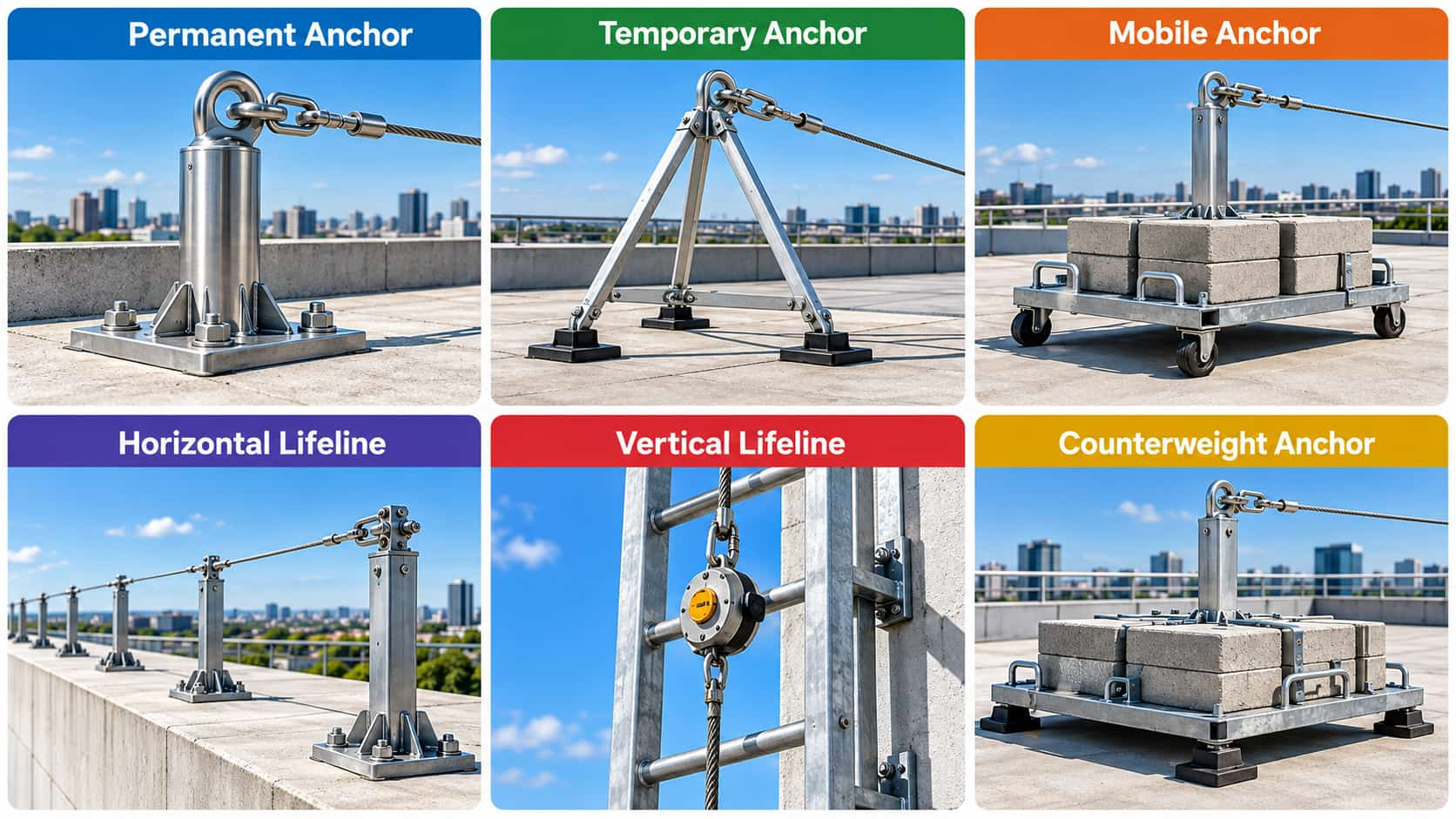
Permanent anchor points are permanently fixed to appropriate structures for repeated or long-term use, depending on the system design and inspection requirements. They are useful in industrial facilities, warehouses and commercial buildings where workers need regular access to elevated areas.
The supporting structure must be suitable for the anchor, and the installation should allow for the required inspections and maintenance.
Temporary Anchor Points
Temporary anchor points are designed for approved temporary applications and must be installed using the specified attachment method. They are removed after the work when the system is designed for temporary use.
Before installation, confirm that the anchor and its attachment method are approved for the supporting structure and follow the manufacturer’s instructions.
Mobile Anchor Devices
Mobile anchor devices allow a compatible connection to move along a designated route or within a defined work area, where permitted by the system design. They are used for some maintenance and construction work where a fixed anchor would prevent movement.
Their suitability depends on the device design, permitted movement, attachment method and compatibility with the fall protection equipment.
Horizontal Lifeline Anchors
Horizontal lifelines are systems with anchor points to support a planned route for worker movement. These systems can have end anchors and intermediate supports. The design shall take into account the forces transferred to the anchors and the deflection of the lifeline during a fall. The complete system must be designed around the supporting structure and the intended work activity.
Vertical Lifeline Anchors
Vertical lifeline systems are used to protect workers who are moving on vertical access routes using suitable anchorages. The connected equipment, lifeline, and anchorage must all be appropriate and compatible with the intended use.
Counterweight Anchor Systems
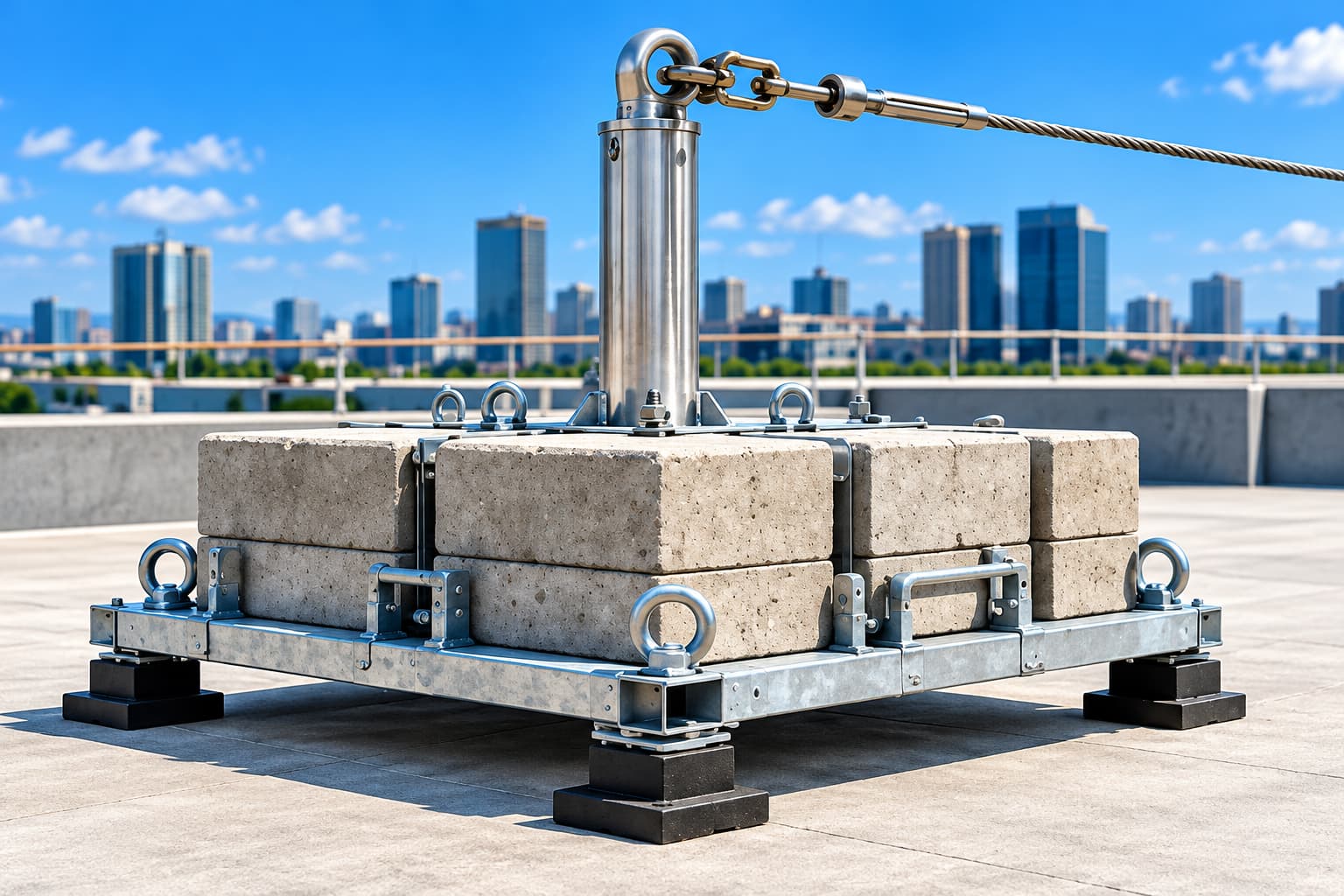
Counterweight anchor systems use weights to keep the system stable, as opposed to traditional structural fixings. Some systems are for approved flat roof applications. Before the installation check the roof surface, load capacity, system restrictions, and manufacturer’s standards. These systems are not recommended for all roofs, and should only be installed where conditions of the roof and system allow.
The following table makes it easier to compare the anchor types, their applications and the main points to consider when selecting a system.
| Anchor Type | Common Application | Main Point to Check |
|---|---|---|
| Permanent | Regular rooftop inspections and equipment maintenance | Long-term structural suitability and inspection access |
| Temporary | Construction and short-term maintenance | Approved attachment method and correct installation |
| Mobile | Work requiring a movable connection point | Permitted movement and equipment compatibility |
| Horizontal Lifeline | Rooftops and elevated areas requiring sideways movement | Anchor forces, supports and lifeline deflection |
| Vertical Lifeline | Towers, fixed ladders and vertical access routes | Anchorage suitability and compatibility with vertical safety equipment |
| Counterweight | Certain approved flat-roof applications | Roof surface suitability and system restrictions |
These options differ in their purpose and system arrangement. The primary difference between permanent and temporary anchors lies in their intended use and duration, while mobile, horizontal and vertical systems are linked to how workers connect and move. Counterweight systems need some roof conditions and are anchored differently. The supporting structure, work requirements and complete fall protection system should always be considered in final selection.
Where Should a Lifeline Anchor Point Be Placed?
Anchor placement is determined by work activity, worker movement and fall hazards in the area. Convenient fixing locations are not always good anchoring locations, as the anchor must be securely connected to a structure that can support the forces generated during a fall
Near the Work Area Without Added Hazards
The anchor should protect the intended task while also allowing workers to safely reach their assigned work positions. The placement needs to be evaluated in terms of roof edges, openings, equipment and the path workers will take. Anchorage arrangement needs to be examined throughout that route and not just at the first unit.
At a suitable height and position
The anchor’s position affects the way the connected equipment operates and the distance a worker may fall. The appropriate location depends on the system design, connecting equipment and intended protection method.
Where fall restraint is used, the arrangement should prevent the worker from reaching the hazard. Where fall arrest is required, the system must be assessed for fall distance, clearance and the potential fall path.
Away from swing-fall and impact hazards
If a worker falls while positioned to one side of the anchor, they may swing into a wall, structural member or item of equipment. The potential path should be considered when deciding where an anchor or lifeline should be installed.
Sharp edges and projecting components also need attention because they may damage lifelines or connecting equipment.
Along the required access route
The anchor layout should match the movement needed to perform the job. A single anchor may be suitable for a defined work position, but an extended route may require a different anchorage arrangement designed for the full work area.
Horizontal lifelines can be considered where continuous movement is required, provided the system is designed for the structure, travel path and intended users.
With sufficient fall clearance
Fall clearance is the space required below a worker to avoid striking a lower surface during a fall. The assessment must consider the complete fall protection arrangement, including the relevant fall distance, equipment deployment and lifeline deflection where applicable.
The required clearance should be calculated for the actual installation. It should not be assumed from the anchor height alone or copied from another project.
Lifeline Anchor Point Requirements for Different Structures
Lifeline anchor point selection depends on the work activity, the required movement, the supporting structure and the design of the complete fall protection system. Before specifying a product, project teams should assess the following factors.
Let’s Talk — Get Your Quote Fast
Need pricing, drawings, or quick product guidance? Contact Hitech Barrier and we’ll respond with a tailored quotation and technical support.
1. Identify the work and access requirements
Determine the task, its location, and the amount of access required by employees. Different anchorage provisions may be required for the servicing of rooftop equipment, maintenance of steel structures and construction work.
Establish whether workers need to stay in one place or move along a horizontal route or vertically. This will help to determine if a single point anchor, lifeline system or other fall arrest system should be considered.
2. Confirm the supporting structure
The anchor must be suitable for the structure to which it will be attached. Concrete slabs, structural steel and lightweight roof assemblies have different properties and fixing requirements.
- Concrete: Check the concrete condition, relevant dimensions, reinforcement where applicable, edge distances and approved fixing method.
- Structural steel: Assess the member, its condition, loading and the proposed connection.
- Metal roof assemblies: Verify the roof construction and supporting framework. A roof sheet should not automatically be treated as a suitable anchor support.
- Existing installations: Confirm the anchor’s identity, condition, documentation and suitability before reuse.
Where the structure or its capacity cannot be verified, an appropriate structural assessment is needed before installation.
3. Match the anchor to the lifeline system
The anchor points, lifeline, harness, connectors and other components must be compatible with the system in which they are to be used. The design must also verify the permissible number of users and the restrictions applicable to the equipment.
For example, a horizontal lifeline can transfer forces to its end anchorages and intermediate supports. These loads should be taken into account in the design of the system rather than treating each anchor as a normal attachment point.
4. Assess Saudi site conditions
Material selection, protective finishes, installation location and maintenance requirements should reflect the site conditions. For outdoor installations in Saudi Arabia, assess exposure to high temperatures, UV radiation, dust, moisture and corrosion. The selected equipment and installation must remain within the manufacturer’s stated operating and environmental limits.
5. Check installation, inspection and documentation requirements
Check the approved design, installation method, and manufacturer’s instructions before proceeding with the installation. Define the verification, inspection and hand-over records needed for the system.
Maintain all applicable installation, inspection and maintenance records and any required certificates or test reports for the system. Project teams should also review the applicable Saudi occupational safety and health regulations and confirm which requirements apply to the project.
6. Consider maintenance and future access
Maintenance, inspection and access to an anchor should be considered since an anchor may be in service for many years. Modifications to buildings and equipment installation can make sites inaccessible, which could affect future inspections.
For facilities with recurring maintenance requirements, a planned anchorage layout can provide suitable access to the needed work areas, and can clarify arrangements for inspection and maintenance.
Final Guidance
A suitable lifeline anchor point for a Saudi project requires more than choosing an anchor type. The anchor location, supporting structure, worker movement and fall clearance must all be assessed against the requirements of the intended work.
Selecting a suitable lifeline safety system requires consideration of the work activity, anchorage requirements and site-specific fall hazards. A site-specific assessment helps ensure that the anchorage and connected equipment are suitable for the application and can be inspected and maintained throughout their intended service life.
Frequently Asked Questions
Who is responsible for approving lifeline anchor points on a Saudi construction project?
The project’s designated safety and engineering personnel should verify that the proposed anchor system meets the approved design, applicable safety requirements and project specifications before it is used.
Can lifeline anchor points be installed on existing buildings in Saudi Arabia?
Yes, lifeline anchor points can be installed on existing buildings if the supporting structure is assessed and confirmed suitable. The installation design should account for the building structure, intended work and forces transferred through the fall protection system.
How often should lifeline anchor points be inspected in Saudi Arabia?
Inspection frequency depends on the manufacturer’s instructions, applicable requirements, project safety procedures and conditions of use. Inspections may also be necessary after a fall, suspected damage or changes to the system.
Can one lifeline anchor point support multiple workers?
Not necessarily. The number of workers permitted depends on the anchor or lifeline system’s approved design, rated capacity and manufacturer’s specifications. Never assume that an anchor can support multiple users without confirmation.
What documents should be maintained for lifeline anchor points on Saudi projects?
Records may include approved design drawings, installation details, inspection reports, applicable test certificates, maintenance records and manufacturer documentation. The exact requirements depend on the system, project specifications and applicable regulations.
Do lifeline anchor points need to be replaced after a worker falls?
Not automatically in every case, but the affected anchor and complete fall protection system must be removed from service until assessed by a competent or qualified person, as applicable. Replacement or other corrective action should follow the manufacturer’s instructions and assessment findings.