
 العربية
 English
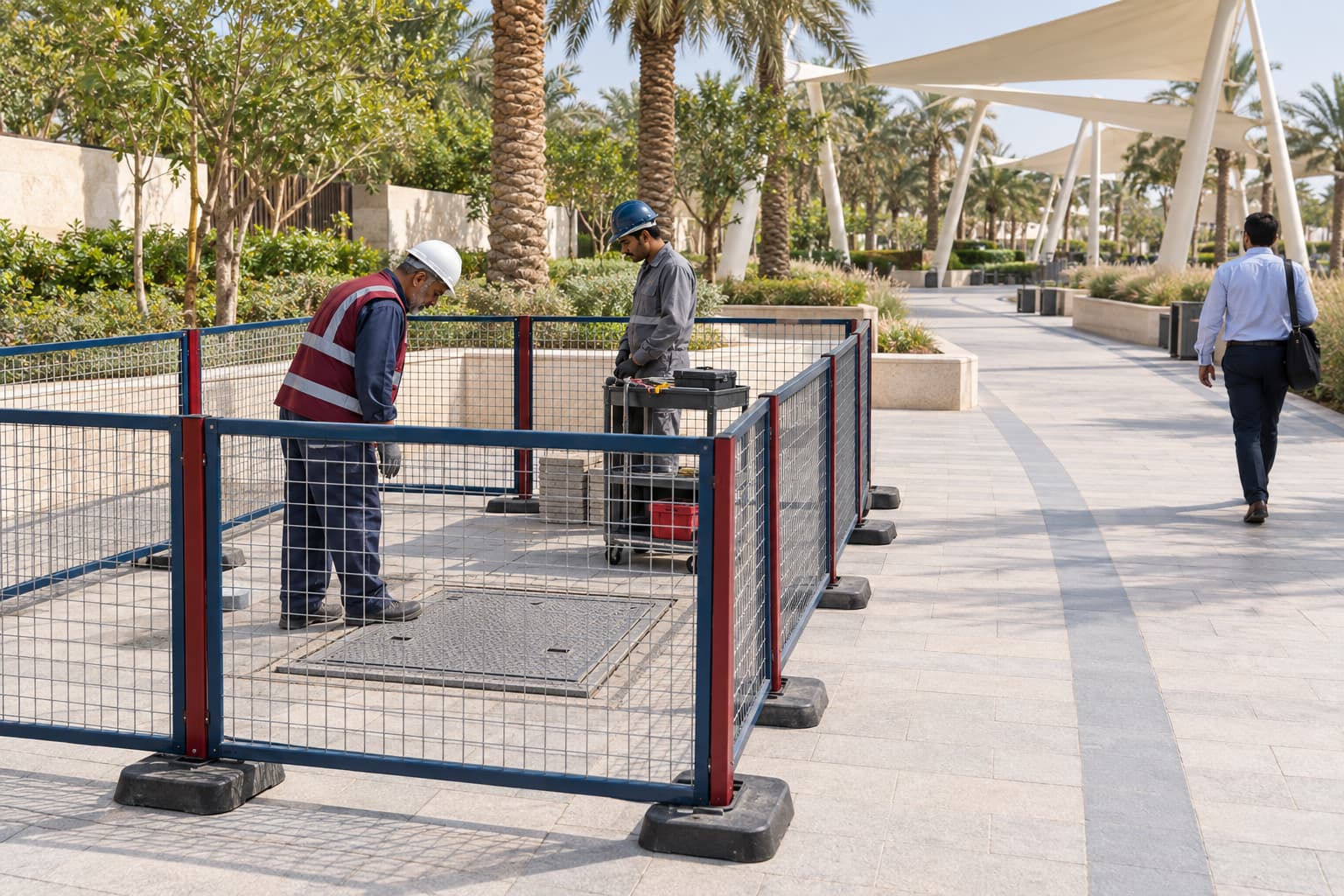

How to Choose a Temporary Safety Barrier for Work Zones and Public Areas
A safety barrier is more than just a work area marking. It clearly indicates locations that should not be entered, keeps people away from hazards, and separates the public from ongoing activity.
The location of the installation and the object it is meant to protect will determine which temporary safety barrier is best. A building entryway undergoing maintenance or a public walkway impacted by construction will require different safety measures than a construction site on a street. The site layout, traffic movement, external circumstances, and the necessary level of protection should all be taken into account when choosing a safety barrier for projects in Saudi Arabia.
Temporary Safety Barriers in Saudi Arabia
In Saudi Arabia, construction sites, utility projects, commercial buildings, public facilities, and infrastructure projects are all surrounded by temporary barriers. Depending on who or what is being exposed to the work, the appropriate system will vary. For road construction, contractors should consult the authorized traffic management plan and Saudi road regulations. In public spaces, pedestrian access, emergency mobility, and any site-specific directives from the facility operator or authority should also be taken into account.
The stability and visibility of installations should be given special attention. Conditions will be more severe for a temporary safety barrier in an open area than for a temporary safety barrier within a building. Finding the hazard is the first step, followed by making sure the temporary safety barrier you select is appropriate for the job. Impact protection must be supported by performance data and product documentation if it is required.
Temporary Safety Barrier Requirements for Work Zones
The first step in the selection of a safety barrier is to identify the hazard and evaluate the site conditions. When choosing a system, keep the following things in mind.
1. Identify the Hazard and Required Protection
Assess if a temporary safety barrier is required to prevent vehicles, excavation, and pedestrians from entering the work area. People can be safely guided and limited areas can be marked with a temporary barrier. However, determine whether a tested automobile restraint system is necessary if there is a chance of vehicle impact. For roadworks, follow the relevant road authority’s requirements and approved traffic management plan.
2. Assess Traffic Speed and Vehicle Type
The vehicle’s size, speed, direction, and potential approach angle. Buses and heavy goods vehicles provide different threats than cars and light delivery vehicles. Where vehicle impact is a consideration, ensure the temporary safety barrier is recorded as performing and being suitable for the site, including conditions outside working hours.
3. Check the Site Layout and Available Space
The temporary safety barrier should safeguard the workspace without limiting access, giving employees room, or restricting view. Check before installation:
- Width of the road and pedestrian way.
- Sight distance for approaching drivers.
- Access for vehicle building and emergency services.
- Space between barrier and work area.
- Space required for movement or deflection in case of impact, where applicable.
- Drainage and ground conditions.
Follow the manufacturer’s installation guidance and required clearances for vehicle restraint systems.
4. Consider the Duration of Work
Installation, maintenance and relocation requirements are affected by the duration and form of work.
Short tasks: Easy deployment, with priorities on visibility and safe pedestrian access.
Work across multiple locations: Portability, storage and ease of relocation.
Longer roadworks: Check the performance of impact, connection, installation and inspection requirements.
Areas subject to heavy vehicles: Verify the protection required and the available clearance.
Public events: Keep pedestrian routes, access points and emergency exits clear.
The amount of protection is not determined by time. A short task near traffic might require more protection than a longer one in a low‑risk pedestrian zone.
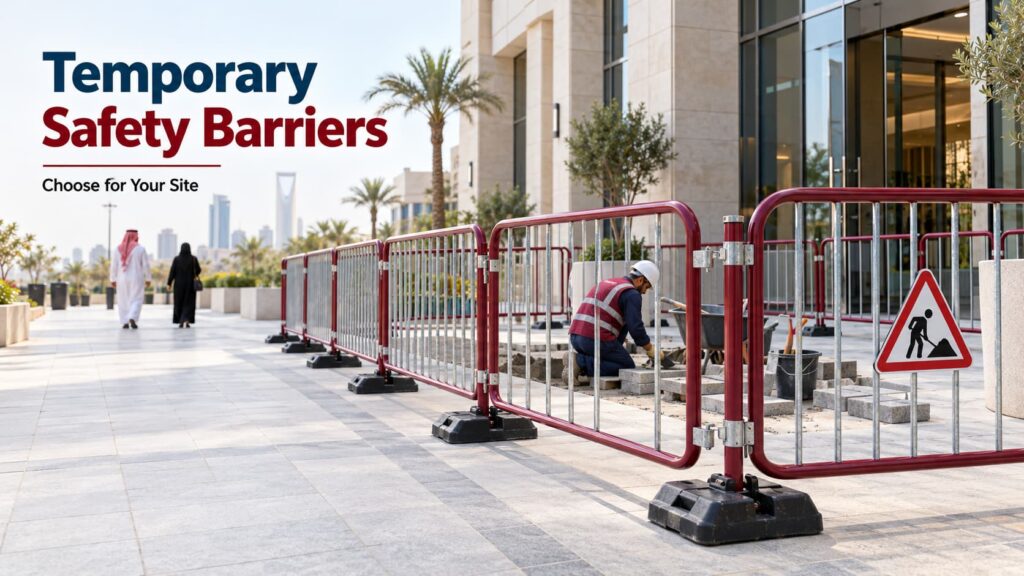
5. Account for Saudi Arabia’s Outdoor Conditions
Outdoor temporary safety barriers in Saudi Arabia are affected by humidity, dust, heat, and direct sunlight in coastal regions. First, make sure the components, coatings, and materials are appropriate for the anticipated conditions.
Read the manufacturer’s instructions on UV resistance and temperature limits if you utilize safety barriers. Verify the finish and maintenance requirements if metal temporary safety barriers are being used.
Start by examining the work area and identifying the hazards. This helps you pick a safety barrier that has a specific purpose and does not just outline the site.
| Key Factor | Why It Matters |
|---|---|
| Site hazards | Determines how much separation is needed between people and the work area. |
| Pedestrian movement | Keeps walking routes clear and reduces the risk of people entering hazardous areas. |
| Nearby traffic | Helps establish whether a visible boundary is sufficient or additional protection is needed. |
| Available space | Helps prevent the barrier from blocking entrances, walkways, or essential access routes. |
| Work duration | Influences how the barrier should be installed and maintained throughout the work. |
| Outdoor conditions | This helps confirm that the materials and installation can survive the expected heat, sunlight, dust and weather exposure. |
Perform these inspections before installation, especially if the work area is close to moving vehicles or public access. Understanding the differences between temporary and permanent safety barriers can help contractors select an appropriate system, depending on project duration, site conditions, and protection needs.
Barrier Requirements for Different Site Locations
The location will dictate the barrier’s placement and what it’s meant to accomplish.
Roadwork areas: workers from the public and moving traffic. The arrangement depends on road conditions and applicable traffic management requirements.
Construction sites: Limit access where work’s in progress or where equipment or materials could pose hazards.
Building maintenance: Protect people from work near entrances, service areas or pedestrian routes.
Public spaces: Keep people around temporary obstructions, but no more than that and avoid creating difficult or unsafe alternatives.
Consider the expected traffic patterns into the work area before finalising the layout. A barrier may look secure from one side. It could still allow access from the side or back.
Temporary Safety Barrier Placement for Safe Access
The work area should be protected by barriers. People should still be able to pass by. This is particularly crucial in areas where cars and walkers share limited area, such as parking lots, sidewalks, and entrances.
Check to make sure that:
- Pedestrians have a route that avoids the work.
- Alternative routes do not lead people into flowing traffic.
- Drivers can understand the road ahead and recognise the obstacle.
- Both necessary entrances and emergency access remain available.
- Gaps help prevent people from accidentally entering restricted areas.
If work progresses or the site layout changes, review the arrangement again because the original position may no longer be sufficient.
Let’s Talk — Get Your Quote Fast
Need pricing, drawings, or quick product guidance? Contact Hitech Barrier and we’ll respond with a tailored quotation and technical support.
Check Stability, Visibility and Durability
The temporary safety barrier must continue to be functional if there is a hazard. When it was first installed, a barrier might have been appropriate. People may be placed in danger if it is compromised or positioned incorrectly.
Before beginning any work, check the ground surface, connections, and installation instructions. For stability, the barrier should be appropriate for the location rather than its weight or appearance. Visibility is equally important.In low light or dusty outdoor settings, the boundary must be visible to individuals approaching the work area.
When working on projects in Saudi Arabia, be aware of dust, heat, and bright sunshine. For installation, use, and maintenance, according to the manufacturer’s instructions.
Assessing Vehicle Impact Risks Before Barrier Selection
Vehicles will cause damage to the impact barrier on a temporary safety barrier. When workers are near moving traffic or when a car could seriously injure them by entering the work zone, this is crucial.
Before selecting a system, ask:
- Is the main purpose to guide people and restrict access?
- Could a vehicle strike the barrier?
- What could happen if the barrier is displaced?
- Does the project require documented impact performance or an approved traffic management arrangement?
When vehicle-impact protection is needed, ensure the proposed system suits the intended application and installation. A visible barrier should not be treated as impact protection unless it is verified for that purpose. For road works, consult the requirements and project specifications before installing.
Temporary Safety Barrier Inspection and Maintenance
Conditions at the site are subject to sudden changes. When equipment moves or deliveries arrive, workers may need to adjust the space. These modifications may leave gaps and reduce the protection given by the initial arrangement.
The following checks should be part of routine site inspections:
- Look out for damaged sections, loose connections, or displaced barriers.
- Make sure that the boundary, where it is required, can be visible and continuous.
- Review the layout when the work area changes.
- Replace or repair any broken parts immediately.
- Restrict the area until the hazard is eliminated.
Taking responsibility for these inspections keeps the barrier a live part of site safety throughout the work.
Final Thoughts
A suitable temporary safety barrier solves the identified problem, suits the site’s architecture, and provides the necessary level of safety. Verified performance, connectivity, and clearance are crucial when workers are exposed to moving traffic, yet portability is an issue in maintenance areas because the layout is constantly changing.
Before a final decision is made, consider the hazard, space, traffic, installation requirements, and the anticipated duration of the work. For projects in Saudi Arabia, check applicable safety regulations and relevant project parameters.
For sites that need temporary vehicle access control, solar-powered vehicle access gates may be relevant. For other applications, select a product based on the site’s actual protection and access requirements. Careful selection, correct installation, and regular inspection help maintain a safe boundary while work is underway.
Frequently Asked Questions
Can temporary safety barriers be reused across different projects?
Yes, temporary safety barriers can be reused if they remain in good condition and are suitable for the new site’s hazards, layout and protection requirements. Check the manufacturer’s instructions before reinstalling them.
Are temporary safety barriers suitable for long-term construction projects in Saudi Arabia?
Yes, some temporary barrier systems are suitable for long-term projects. The selection should account for project duration, site conditions, traffic exposure and the applicable project requirements.
What documents should contractors request when purchasing temporary safety barriers?
Contractors should request product specifications, installation instructions and relevant test or performance documentation. For roadworks, they should also confirm that the proposed system meets the applicable Saudi requirements and project specifications.
Can temporary safety barriers be installed on uneven ground?
Installation depends on the barrier design and the condition of the surface. Check the manufacturer’s installation requirements and confirm that the ground can support the system safely before installation.
Should temporary safety barriers be rented or purchased for a project?
Renting may be suitable for short-term work or projects with changing requirements. Purchasing may be more practical when barriers are needed regularly across multiple projects. Consider the project duration, reuse potential, storage and maintenance costs before deciding.