
 العربية
 English


Vehicle Access Control Systems in Saudi Arabia: Secure, Automated Entry with Barriers, ANPR and RFID
A vehicle access control system in Saudi Arabia is a set of barriers, identification devices and software that determines whether vehicles are allowed to enter or exit a location before automatically opening the gate. Most systems in Saudi Arabia combine a boom barrier with ANPR cameras or RFID tags, and add bollards where a site must stop a vehicle by force.
Managing vehicle mobility is an important part of security and traffic control at industrial facilities, warehouses, commercial buildings, residential compounds, parking areas and other controlled sites. Depending on the project, a system may include automatic boom barriers, ANPR/LPR cameras, RFID readers, vehicle detection sensors, access control software, CCTV, and security bollards.
How Does Vehicle Access Control Work?
Vehicle access control system is a comprehensive solution for identification, authorization, monitoring and control of vehicles at entry and exit points. This system is capable of authenticating a vehicle with a valid credential like a license plate, RFID tags, access cards or other authorized manner instead of manual security checks. The associated gate or barrier can be opened automatically after verification of authorization.
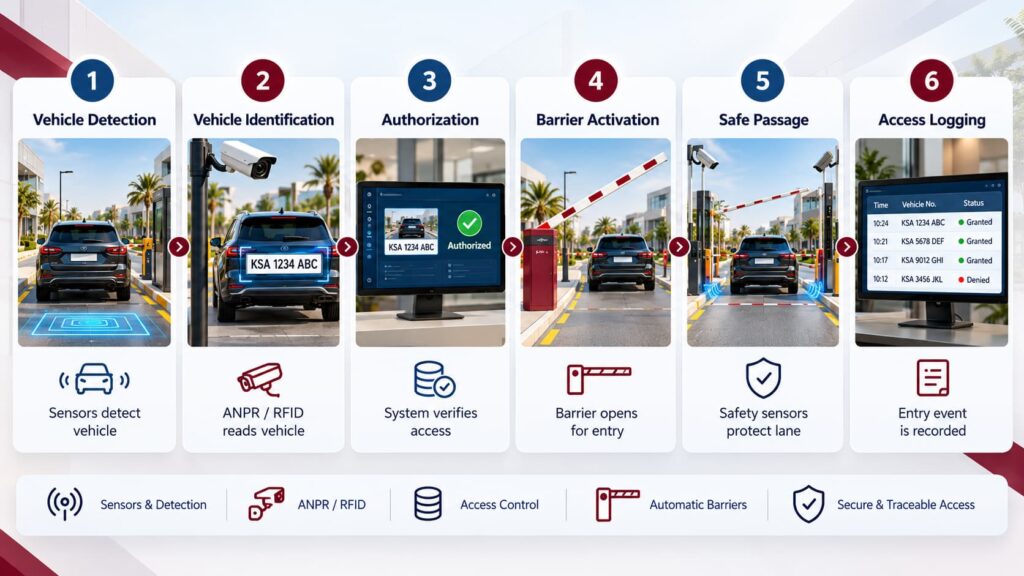
The system begins by detecting the approaching vehicle at a controlled entrance by using an ANPR camera, RFID tag, access card or other authorized credential. The recorded data is compared to the access control system to confirm the vehicle’s access to enter or exit. Where entry is authorized, the system activates the boom barrier or gate to permit the vehicle to pass.Within the control area, vehicle detection and safety systems monitor the position of the vehicle and its whereabouts and prevent the barrier from closing.
CCTV, access control software, or a centralized security platforms record and monitor access events, this lets facilities to keep track of approved access activity while controlling vehicle movement. A vehicle access control system normally combines several technologies that work together rather than operating as separate devices.
The vehicle access control process usually includes the following steps: The system confirms it has access authorization after locating and identifying the car. If the barrier or bollard is authorized, safe and supervised entry is made possible with sensors and CCTV.
Key Devices & Technologies Used to Control Vehicle Access in Saudi Arabia
A vehicle access control system utilizes a range of technologies and equipment to identify vehicles, verify authorization, control physical access and ensure vehicles move safely. The exact components depend on the facility, traffic volume, security needs and level of automation
Boom Barriers: Controlling the Physical Lane
A boom barrier provides the physical control point. It raises to allow an authorized vehicle through and returns to its closed position after passage. The barrier could be the main access system for a standard entrance. In a high-traffic environment, opening speed, duty cycle, boom length, safety detection, and traffic volume become crucial design elements.
ANPR: Identifying the Vehicle by Its Plate
ANPR (Automatic Number Plate Recognition) or License Plate Recognition (LPR) is a technology that uses cameras to identify a vehicle by its registration plate.
This is important when the site wants vehicles to be recognized without drivers having to provide a card or RFID credential. An industrial facility can, for instance, keep a registry of authorized company vehicles and include license plate recognition into the entry process. The visitor vehicles can follow a separate authorization process
RFID: Recognizing Authorized Vehicles
RFID (Radio Frequency Identification) makes use of a tag or credential that is associated with the vehicle that is approved. For the group of frequent users such employees, residents, fleet vehicles or registered contractors, who use the same gate daily. When a project calls for multiple vehicle identification methods, RFID and ANPR can be used together for dual verification.
Bollards: When a Boom Barrier Is Not Enough
A boom barrier controls a lane, but can not have the same physical stop determined vehicle. Automatic rising bollards at restricted entrances, and fixed security bollards permanent block areas vehicles must never enter.
Vehicle Detection Sensors: Detecting Vehicle Movement
Vehicle detection sensors detect when a car enters, stops inside, or travels through an access lane. The access system can receive vehicle-presence data from technologies like radar and induction loops. This promotes safer and more regulated vehicle traffic and helps coordinate barrier operation.
Access Control Software: Managing Access Decisions
The access control software is the management layer that connects identification devices, barriers and access records. It can control vehicle usage, set access rights, impose entry rules and record access activity. This way different technologies work together as a coordinated vehicle access system.
Safety Devices: Supporting Safe Barrier Operation
Safety devices help prevent unsafe barrier movement when a vehicle or obstacle is detected in the access lane. Photocells, safety sensors, and vehicle detectors can signal the system to stop or prevent barrier movement when an obstruction is present. Their configuration should be selected according to the barrier system, site conditions, and applicable safety requirements.
CCTV Cameras: Monitoring Vehicle Access
CCTV cameras visually monitor the vehicle entrances and exits. They can help security teams to verify vehicles, monitor access activity and review recorded events as needed. CCTV can also be integrated with ANPR and other access-control technologies to provide a clearer view of vehicle movements and security incidents.
Let’s Talk — Get Your Quote Fast
Need pricing, drawings, or quick product guidance? Contact Hitech Barrier and we’ll respond with a tailored quotation and technical support.
Vehicle access control systems can employ a combination of technologies to identify vehicles, verify access, monitor activity and control entry points. In Saudi Arabia, boom barriers and automatic bollards can be implemented with these technologies to make the vehicle entry process more controlled and automated.
| Technology | What It Does | Works With |
|---|---|---|
| ANPR / LPR | Identifies vehicles by reading number plates | Boom barriers & automatic bollards |
| RFID | Identifies authorised vehicles using RFID tags | Boom barriers & automatic bollards |
| CCTV | Monitors vehicles and access points | Boom barriers & automatic bollards |
| Vehicle Sensors | Detects vehicles at the entrance or exit | Boom barriers & automatic bollards |
| Access Control Software | Manages who can enter and records access | Boom barriers & automatic bollards |
| Intercom | Lets drivers communicate with security staff | Boom barriers & automatic bollards |
| Safety Devices | Helps prevent unsafe operation | Boom barriers & automatic bollards |
Vehicle Access Control Applications and Facility Requirements in Saudi Arabia
Vehicle access control can be designed for different different environments across Saudi Arabia, such as
Industrial Facilities and Factories
Industrial sites may have different access for heavy vehicles, deliveries, contractors, and employees. These entrance points can be arranged while facilitating regulated mobility within the site with the use of automated barriers and vehicle identification.
Warehouses and Logistics Facilities
Warehouses often handle vehicle movement from trucks, delivery vehicles, employees, and contractors. A well-designed access system can reduce the number of manual checks by controlling entry and exit lanes.
Commercial Buildings and Offices
Vehicle access control can be used by companies for visitor management, employee parking, controlled access points and restricted areas. In order to track vehicle movements and keep track of access, the system can also interface with CCTV and access control software. This enables businesses to handle regular workers, guests, and service vehicles in accordance with their access needs.
Residential Compounds
Vehicle access control is applicable at restricted vehicle entry points, visitor management and employee parking at commercial buildings and workplaces. ANPR, RFID or access cards could be used to identify authorized cars and reduce the need for human inspections.
Parking Facilities
Parking facilities shall control vehicle traffic at entry and exit points and restrict access to parking spaces. ANPR or RFID can be used for entry without tickets or with credentials but can manage lanes with automated boom barriers.
Operational and Security Advantages of Vehicle Access Control Systems in Saudi Arabia
A well designed vehicle access control system can help to identify, authorize, monitor and manage vehicles at controlled entrances. The main operational benefits include:
- Controlled access: Vehicle entry or exit may be controlled by preestablished authorization requirements.
- Streamline vehicle movement: Barrier operations and recognition could be automated to reduce manual checks and permit better handling of vehicles.
- Traffic flow organization: Correctly configured barriers, sensing systems and lane restrictions can help to facilitate smoother travel at busier entrances.
- Traceable access record: The access and exit events can be recorded for access management, security review and operation monitoring.
- Centralized Control: An integrated access control platform facilitates the monitoring and management of multiple vehicle entrances.
- System integration: The vehicle barriers can be integrated with parking systems, ANPR, RFID, CCTV, intercoms and security technology.
- Scalable access control: The system can be expanded to support multiple access points or set up for a single entrance as site requirements change.
Factors to Consider When Choosing a Vehicle Access Control System
There is not a universal vehicle access control solution for every site. The best system is site layout, traffic patterns, security needs and level of access control. When choosing equipment, take into account the following:
1. Traffic Volume
To determine the required system capacity and speed of opening, evaluate the volume of vehicles using the entrance during normal and peak operating hours.
2. Lane Width
The proper boom length and barrier configuration also depends in part on the site layout and entry width.
3. Identification Method
Select the access techniques based on the needs of the facility. ANPR, RFID, access cards, remote controls or a combination of these can be used.
4. Security Level
The site determines the level of physical protection required. A boom barrier may be good enough for a standard commercial entrance but at higher security sites, you may want bollards or road blockers.
5. Operating Environment
Choosing a system for outdoor installation requires taking into account the environmental conditions of the location and the degree of protection of the equipment.
6. Integration Requirements
Consider whether the vehicle access system requires the integration of CCTV, parking management, access control, intercom, visitor management, or centralized security software.
7. Safety Requirements
Safety features in the design of a system include vehicle identification sensors, photocells, warning lights, emergency release and suitable control logic.
Vehicle Access Control Design, Site Assessment and Data Protection
Instead of choosing a vehicle access control system, mainly based on the specifications of each piece of equipment, it should be developed with the site’s actual conditions and requirements in mind.
The number and width of vehicle lanes, traffic volume, vehicle types, entry and exit patterns, identification techniques, barrier operation standards, safety clearance, power and communication infrastructure, emergency access, and future expansion are all determined with the aid of a site assessment. The assessment also helps determine how technologies such as vehicle detection, RFID, ANPR, barriers, and access control software should work together as one system.
Where the system makes use of technologies that collect or process information about persons or vehicles, data protection should be taken into account. While ANPR can scan the license plate data and the access control system can record the vehicle movements and entrance events.
Companies should also be aware of the relevant provisions of Personal Data Protection Law (PDPL) when collecting, holding, accessing or processing personal data in Saudi Arabia. When you design a system, you have to consider physical access and security requirements, data processing, access permissions, preservation, and information-security procedures.
Conclusion
A vehicle access control system in Saudi Arabia combines automatic barriers, ANPR or RFID identification, vehicle detection, CCTV and management software to give controlled, traceable entry. The right setup depends on traffic, security level, layout, environment and integration needs.
A properly designed system can help control vehicle movement and maintain traceable access records for business buildings, residential compounds, parking lots, industrial facilities, warehouses and high security locations. A site assessment also helps determine how well each technology should work to meet the business’ specific needs.
When selecting a system, companies should think about not only the equipment but also about safety, integration, future expansion and the relevant data protection regulations. In an effort to provide a more coordinated vehicle access solution for physical lane control, boom barriers can be combined with identification and monitoring systems.
Frequently Asked Questions
Find answers to common questions about boom barriers, automatic bollards, ANPR, RFID, vehicle access control systems and security requirements for facilities in Saudi Arabia.
Are boom barriers enough for high-security vehicle access?
A boom barrier controls access through a lane but is not designed to physically stop a determined vehicle. For higher-security locations, additional physical protection such as automatic bollards or road blockers may be required alongside vehicle identification and monitoring technologies.
What should you consider when choosing a vehicle access control system in Saudi Arabia?
Key considerations include traffic volume, lane width, vehicle identification method, security level, operating environment, integration requirements and safety requirements. A site assessment can help determine the appropriate combination of barriers, identification and monitoring technologies.
Can ANPR and RFID be used together?
Yes. ANPR and RFID can be integrated to provide multiple vehicle identification methods. For example, RFID can identify registered vehicles while ANPR can provide license-plate-based identification for other vehicles or visitors.
Is a site assessment necessary before installing vehicle access control?
A site assessment is useful for determining the appropriate system configuration. It can consider lane dimensions, traffic volume, vehicle types, access patterns, identification methods, safety clearance, power and communication infrastructure, and emergency access requirements.
Can ANPR cameras read Saudi number plates correctly?
Saudi plates show four digits and three letters in both Arabic and English. Choose an ANPR system whose recognition engine is trained for Saudi plates and can read both scripts. Dirty or damaged plates, glare and dust on the lens can still reduce accuracy, so camera position and regular lens cleaning matter. Adding RFID gives you a backup identification method.
How often does the system need maintenance in Saudi conditions?
Dust can build up quickly on camera lenses, photocells and readers, so outdoor systems in Saudi Arabia usually need more frequent cleaning and checks than systems operating in milder climates. A preventive maintenance contract with a local supplier can help keep barriers, sensors and cameras working reliably, especially after sandstorms.
Do industrial and high-security sites in Saudi Arabia need crash-rated barriers?
Facilities that fall under the High Commission for Industrial Security (HCIS) must follow its security directives, which can include specific requirements for vehicle barriers at perimeter entrances. Where protection against hostile vehicles is needed, barriers and bollards may be selected based on recognised crash-test standards such as ASTM F2656, IWA 14-1 or PAS 68. The exact requirement should be confirmed with the relevant security consultant and project authorities.
How do Civil Defense and ambulance vehicles get through in an emergency?
The design should include emergency access, such as a manual override, a remote-open button in the guard room or a dedicated emergency lane. This helps ensure Civil Defense, Saudi Red Crescent and police vehicles are not unnecessarily delayed at the gate during an emergency.
How does the system stop the barrier from closing on a car?
Vehicle detection sensors, such as induction loops or radar, and safety devices such as photocells can detect a vehicle or obstacle in the lane. They can then stop or prevent barrier movement until the lane is clear.
Can the system connect to my existing CCTV, parking or security software?
Yes. Access control software can integrate barriers, ANPR, RFID, CCTV, intercoms and parking or security systems so that different components can work together as one access management system. Integration compatibility should be confirmed during system selection and site assessment.