
 العربية
 English

Boom Barriers in Saudi Arabia: Types, Applications and Selection Guide
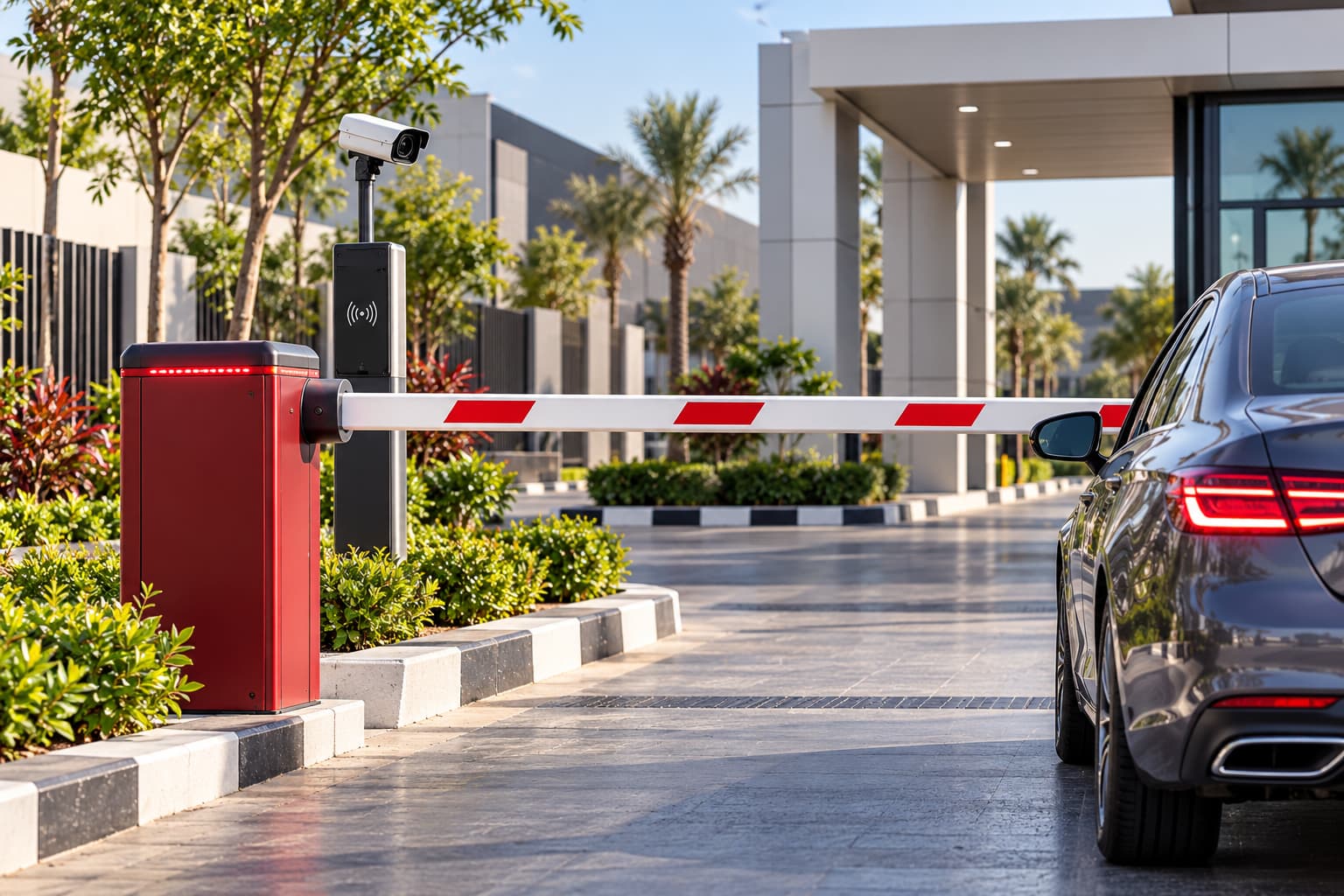
Boom barriers are installed at the entry and exit points of parking lots, residential and commercial buildings, and industrial areas to control the entry and exit of vehicles. In Saudi Arabia, boom barriers help control vehicle access at entrances while keeping traffic moving efficiently. The barrier has to suit the entrance layout, traffic volume, operating frequency, and access-control requirements. Outdoor conditions, safety devices, and maintenance needs also affect its long-term performance.
The different types of boom barriers, their applications, and the factors to consider when choosing a boom barrier system for your facility in Saudi Arabia are all addressed in this guide.
How Boom Barriers Control Vehicle Access
A boom barrier is a long-arm device used for vehicle access control that can be lifted to allow entry or lowered to deny entry. When access is granted, the arm lifts from its horizontal closed position to allow the vehicle to pass. It lowers after the lane is clear and closure is safe. Most systems are made up of three basic parts:
- Barrier arm: Opens or blocks the vehicle lane.
- Drive mechanism: Raises and lowers the arm.
- Control unit: Receives commands and manages the barrier’s operation.
The control unit of an automatic system receives an opening command from the remote control, access card reader, or compatible vehicle access control system.
At an office parking entrance, an authorised driver presents an RFID credential. The controller raises the arm after the access decision, subject to safety interlocks. A vehicle detector or safety sensor may be used to prevent the arm from closing while a vehicle is passing.
The barrier provides physical access control, and connected equipment provides identification and authorization where needed.
Types of Boom Barriers
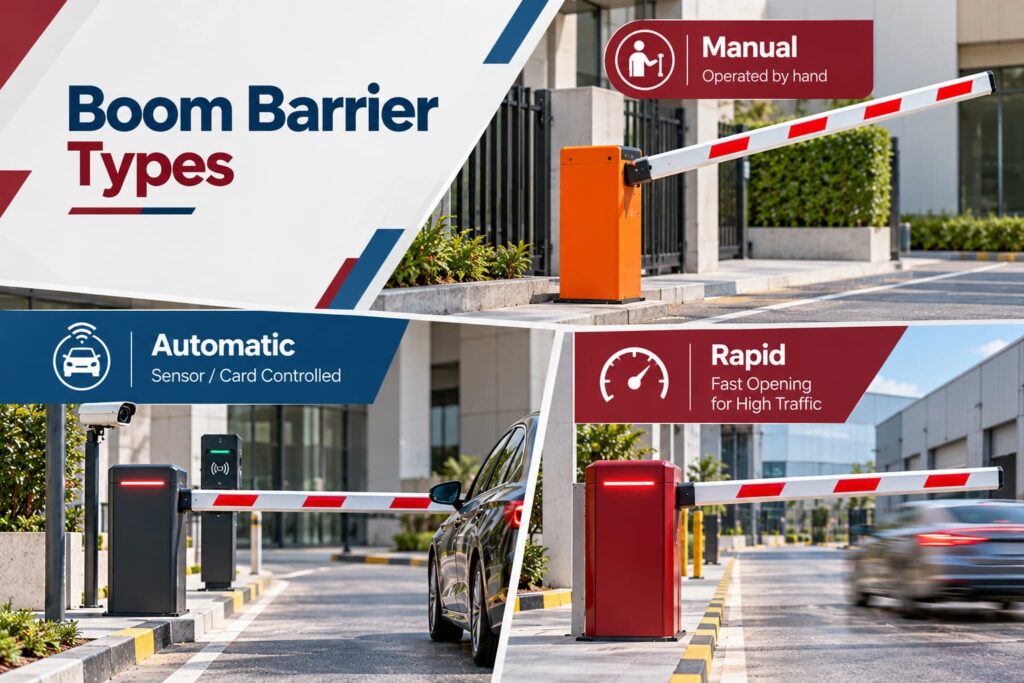
A range of boom barrier configurations is available to suit entrance layouts and traffic requirements. The main types are manual, automatic, rapid-operation and heavy-duty barriers.
- Manual Boom Barriers
Manually operated boom barriers are not powered by a motor. They work well at low-volume locations where an attendant is stationed to control access and limited vehicle movement. Manual operation may also be appropriate according to the needs of the site, and these could also be considered as temporary access points.
- Automatic Boom Barriers
Automatic boom barriers are powered to raise and lower the arm. They can be used with RFID cards, remote controls, ANPR cameras and other access-control equipment depending on the model and system configuration. The automatic boom barrier can be suitable with:
- RFID cards and access readers
- Automatic number plate recognition (ANPR)
- Remote controls and push buttons
- Vehicle detection and safety sensors
The barrier controls the flow of vehicles and the linked access-control system controls entry permissions.
Automatic boom barriers are commonly specified for residential compounds, offices and parking facilities with regular vehicle movement, subject to model duty limits.
- Rapid-Operation and Heavy-Duty Boom Barriers
Rapid-operation barriers are for entrances where a shorter opening cycle is important. Heavy-duty models are designed for demanding operating conditions and frequent barrier cycles. These have different performance considerations, so the right model should be chosen based on the requirements of the site.
It is suitable for busy vehicle entrances, logistics facilities, warehouses and sites with frequent daily operation.
| Type | Main characteristic | Best suited for |
|---|---|---|
| Manual | Operated by a person | Occasional vehicle movement |
| Automatic | Motorised opening and closing | Regular vehicle access |
| Rapid-operation | Faster opening cycle, depending on model | Entrances where queues need to be managed |
| Heavy-duty | Designed for demanding operating cycles | High-use commercial and industrial entrances |
Note: Rapid-operation and heavy-duty describe performance characteristics; they are not necessarily separate from automatic operation.
Applications of Boom Barriers in Saudi Arabia
Boom barriers regulate vehicle entry at parking, commercial, residential and industrial entrances. They may operate independently or integrate with access-control systems.
Parking Areas and Commercial Buildings
Boom barriers are used in shopping malls, office buildings and paid parking facilities to control vehicle entry and exit. The barrier can be integrated with a ticketing, payment or parking management solution.
Imagine how many vehicles arrive at busy entrances during peak hours. If opening cycles or payment processing takes too long during peak periods, queues can extend beyond the entrance and disrupt nearby traffic.
Let’s Talk — Get Your Quote Fast
Need pricing, drawings, or quick product guidance? Contact Hitech Barrier and we’ll respond with a tailored quotation and technical support.
Residential Compounds, Hotels and Offices
Residential compounds and offices may need different access permissions for residents, employees, visitors and service vehicles. An automatic boom barrier can work with access cards or remote control. You might also need reception staff or a visitor management system to manage visitor entry.
The entrance layout should aid how people use the site. For example, a hotel may need space for taxis and drop-offs, while a residential compound may need separate lanes for residents and visitors.
Warehouses, logistics facilities and industrial sites
During the day, factories, warehouses and logistics facilities may have employee vehicles, delivery trucks and contractor traffic.
For these entrances, check the lane width, type of vehicles, frequency of operation and turning space available. The barrier arm should fit into the entrance without interfering with surrounding traffic or passage of larger vehicles.
The boom barrier might be part of a larger access control system where additional security is necessary.
Restricted-Access and High-Security Areas
Some places require additional checks before a vehicle can enter. A boom barrier can provide controlled access, supported by security personnel, vehicle identification and inspection procedures.
Standard boom barriers regulate vehicle access to high-security locations, but they shouldn’t be trusted to prevent a vehicle from attempting forceful entrance. A specific vehicle security barrier with confirmed crash-test performance might be required if a facility needs impact protection. Prior to designating a product for security-critical applications, always verify its tested impact-resistance rating.
Assess the entry and the purpose of the system before selecting a boom barrier. The following factors can help to narrow down the suitable options.
| Selection factor | What to check |
|---|---|
| Traffic volume | Estimate the number of vehicles entering and leaving, including peak-hour traffic. |
| Lane width | Choose an arm that can cover the clear entrance width within the model’s specifications after measuring it. |
| Opening speed | To manage lines, consider whether standard or faster operation is required at the entrance. |
| Operating frequency | Check that the model is rated for the expected number of opening and closing cycles. |
| Access control | Check compatibility with RFID cards, ANPR, remote controls or an existing parking system where necessary. |
| Outdoor conditions | Check the specified operating temperature range and protection against dust and other site condition for Saudi installations. |
| Maintenance and support | Review servicing needs, spare-part availability and access to technical support. |
Factors to Consider Before Installing a Boom Barrier
Before choosing a boom barrier system, consider these important factors.
- Traffic volume: Check how many vehicles use the entrance, especially during peak hours.
- Arm length: Measure the lane width and confirm that the selected model can cover the opening safely.
- Opening speed: Choose a suitable speed to help manage queues without compromising safe operation.
- Operating frequency: Make sure the barrier is rated for the expected number of opening and closing cycles.
- Access control: Check compatibility with RFID, ANPR, access cards or parking systems.
- Weather conditions: Verify the model’s operating temperature and ingress-protection ratings for the expected dust and outdoor conditions.
- Maintenance support: Check servicing requirements, spare-part availability, and local technical support.
Safety and Installation Considerations
Verify the model’s operating temperature and ingress-protection ratings for the expected dust and outdoor conditions.
- The barrier must be securely anchored to a suitable foundation.
- Confirm the arm can raise and lower through its full travel without striking structures, vehicles or other obstructions.
- Ensure proper installation and testing of vehicle detectors and safety sensors.
- Pedestrian walkways must remain clear of the barrier’s operating area.
- The access-control system and warning indicators must be functional.
- The installation should be thoroughly checked before it is put into operation.
Follow the manufacturer’s instructions for installation and maintenance. Use qualified personnel for commissioning and repairs.
Conclusion
The right boom barrier depends on how an entrance is used and how frequently vehicles pass through it. The necessary arm length, daily operating frequency, and whether the system needs to connect with parking management or other access control systems should all be taken into account before selecting one. For example, a small private parking lot may only need a simple system, but a busy commercial entrance will likely require an automatic system with integrated parking controls.
Before requesting a quotation, you will need to have the following information available: lane measurements, expected traffic volumes, opening speed required, and access control requirements. The supplier must confirm the proposed model’s arm length, operating cycle, safety features, and environmental ratings.
The right boom barrier should match your daily operating needs, traffic flow, and entrance layout. Examine the available boom barrier systems and get a quote based on your lane width, expected traffic volume, operation cycles, and access-control requirements before deciding on a model.
Frequently Asked Questions
Which boom barrier is suitable for busy entrances?
An automatic boom barrier rated for the expected traffic and operating frequency is generally suitable. Rapid-operation models may help reduce waiting times where traffic demand is high.
How do I choose the correct boom barrier arm length?
Measure the clear entrance width and check the maximum arm length supported by the selected model. Nearby structures and the movement of vehicles should also be considered.
Can boom barriers work with RFID and ANPR systems?
Yes. Compatible boom barriers can connect to RFID readers or ANPR systems to manage authorised vehicle access.
Are boom barriers suitable for outdoor use in Saudi Arabia?
Yes, if the selected model is rated for the site’s environmental conditions. Check its specified temperature range, dust protection and installation requirements.
How often should a boom barrier be maintained?
Maintenance frequency depends on the model, usage and environmental conditions. Follow the manufacturer’s recommendations and inspect the arm, mechanism, sensors and control system regularly.